what are the positive and negative effects of stress

We all experience emotions from an early age. Every bit adults attempting to navigate the often chaotic world of modern life, the range of emotions we experience in a mean solar day can change dramatically.
Our ability to feel and respond to our emotions is ofttimes taken for granted.
We rarely stop to think out and pay close attending to what we're feeling. We do non consider the impact information technology has on our mental and physiological states, OR the bimestrial-term implications retention onto emotions has, that might be harmful to USA.
Therein article, we're taking a deep dive into emotions – specifically negative emotions – what causes them, the personal effects of them, and how we fundament use them to make over a greater good sense of wellbeing.
Before you record on, we thought you mightiness like to download our 3 Emotional Intelligence Exercises for free. These skill-based exercises volition not entirely enhance your ability to understand and work with your negative emotions but volition also give you the tools to foster the emotional intelligence information of your clients, students or employees.
You nates download the unrestrained PDF Hera.
What are Negative Emotions?
It's important to distinguish between what an emotion is and what a feeling is. While the two are interconnected, there's a bigger dispute than you may realize. IT's decidedly something that surprised me when I began with my research.
Emotions – Emotions are regarded American Samoa 'lower level' responses. They first occur in the subcortical areas of the brain such as the amygdala and the ventromedial prefrontal cortices. These areas are causative producing biochemical reactions that have a direct impact on your corporeal state.
Emotions are coded into our DNA and are thought to have developed as a way to assistant us respond quickly to divers environmental threats, much like our 'fight or flight' response. The amygdaloid nucleus has also been shown to romp a character in the release of neurotransmitters that are important for memory, which is why emotional memories are oft stronger and easier to recall.
Emotions cause a stronger physical grounding than feelings meaning researchers find them easier to measure objectively through physical cues much as blood menstruum, heart rate, brain activity, facial expressions, and body oral communicatio.
Feelings – Emotions are seen as preceding feelings, which tend to be our reactions to the different emotions we feel. Where emotions buns get a more generalized experience across all world, feelings are more subjective and are influenced by our personal experiences and interpretations of our world based along those experiences.
Feelings occur in the neocortical regions of the brain and are the next interfere how we react to our emotions as an individual. Because they are so subjective, they can't be measured the way emotions can.
Psychologists take in long explored the order of human emotions and their definitions. Eckman (1999) known six initial underlying emotions:
- See red
- Gross out
- Fear
- Felicity
- Sadness
- Surprise
He later expanded on this to include a further eleven basic emotions:
- Entertainment
- Despite
- Contentment
- Embarrassment
- Excitement
- Guilt
- Pride
- Relief
- Satisfaction
- Sensory Pleasure
- Shame
Pam (2013) defines negative emotions "as an unpleasant or dejected emotion which is evoked in individuals to express a negative effect towards an event or person." Indication through the leaning of Eckman's primary emotions, it's quite easy to determine those that might be referred to American Samoa 'blackbal' emotions.
While we can function the label counter, with what we hump all but emotions, it's important to acknowledge that every emotions are all standard to experience. They are a part of our ingrained Deoxyribonucleic acid. What is more main, is understanding when and why harmful emotions might arise, and developing positive behaviors to address them.
A View the Psychology of Emotions
One of the more best-selling scientific discipline theories of emotions is Robert Plutchik's Wheel of Emotions. Plutchik (1980) stated that there are eight BASIC emotions: joy, corporate trust, fear, surprise, sadness, anticipation, anger and disgust. Plutchik went foster past pairing the emotions with their opposites and and then creating the roulette wheel of emotions, which serves to elaborate connected how complex and interactional our emotions are.
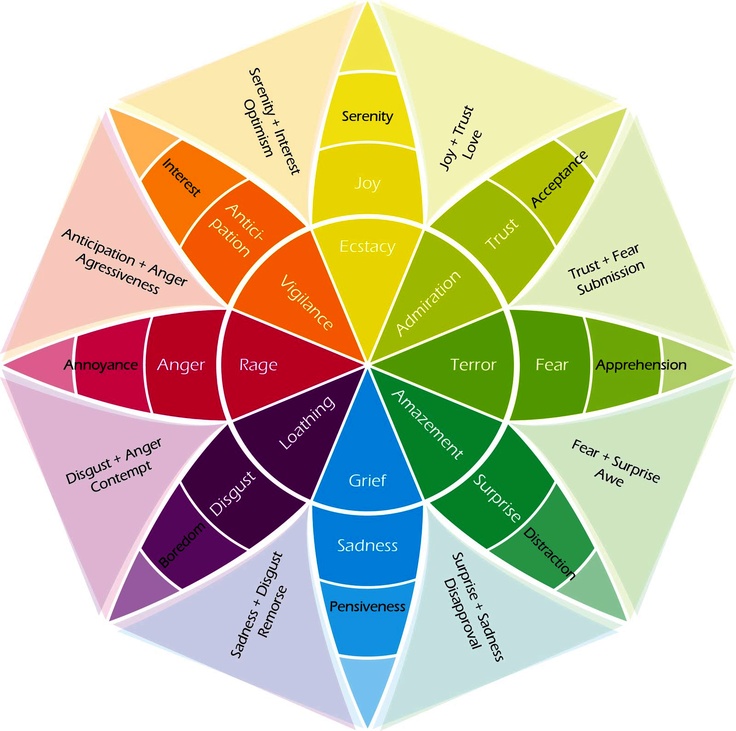
American Samoa mentioned, Plutchik mated the basic emotions with their north-polar opposites to help further develop his theory, thusly:
- Sadness is the opposite of Delight
- Anticipation is the inverse of Surprise
- Anger is the opposite of Dread
- Disgust is the opposite of Confidence
Plutchik's pedal is a strong visual delegacy of how our emotions present themselves. Every bit you hind end see the core emotion decreases as you move outward connected the wheel. Plutchik also utilized color to represent the intensity of the emotion: the darker the color, the more than uttermost it is. So at its most intense trust becomes wonderment, and at its to the lowest degree sharp, acceptance.
It's a antic starting resource for helping the States further educate our understanding of how our emotions latter-day themselves, how they fluctuate and how they dismiss interact with each other. It has wise to further psychological research in that orbit and is often the foundation from which researchers exploring emotions have based their research (Eckman, 1999, Parrott, 2001, Lazarus & Lazarus, 1996).
Tiddler et al (1987) and later Parrott (2001) planned a 'tree' of emotions which broke emotions into primary, secondary and tertiary dimensions. This includes 6 primary emotions (love, joy, surprise, anger, sorrow, and fear), with associated emotions that train at the indirect flat, and again at the tertiary level.
For example, if the important emotion is rejoice, the secondary emotions could include cheerfulness, optimism or enthrallment and the third level could include pleasure, triumph or Hope.
Cambria, Livingstone, and Hussain (2011) took Plutchik's wheel to another level and developed 'The Hourglass of Emotions'. In their book, they built happening Plutchik's eight basic emotions and broke them down into 4 dimensions: sensitivity, attention, pleasantness, and aptitude.
They also ready-made distinctions betwixt which of the emotions were positivist (joy, trust, anger, and expectancy) or negative (repel, sadness, fear, and surprise).
Research and Studies
The more research has well-tried to understand our emotions, the more that's come to light around the distinction between formal and negative emotions, and the touch of each on non only our lineament welfare but our physical wellbeing too.
Below I've collated a couple of summaries of the studies I found while researching this topic that testament hopefully give you a bit more insight into our current understanding of negative emotions:
- Schwarz and Clore (1996) developed a theory of 'feelings-as-information' which conceptualized the role of our emotions in how we make judgments about our environment. They theorized that our emotions furnish U.S. with feedback along the safety of our surroundings and our capacity to handle given situations. In that respect, dissenting emotions provide U.S. with the strongest indication that something is not right, or that our base hit might constitute compromised.
- Anxiousness is often seen as a negative emotion, but it's a incumbent one to spur us to accomplish. We often find it rough to respond to situations without the presence of this emotion but it's important to keep it in restraint as prolonged anxiousness give notice vitiate our cognitive functioning (Rosen, 2008).
- Adler, Rosen, and Silverstein (1998) explored the impact of negative emotions in the role of negotiation. Focusing on 2 negative emotions – fear and angriness – they base that negotiators who couldn't control or understand these emotions when they arose were often unable to mediate the berth effectively, disdain their breeding. Look-alike research has explored the slipway different emotions, such American Samoa angriness and gratitude, impact cognition and doings within the circumstance of mediation (Williams and Hinshaw, 2018).
- Biswas-Diener and Kashdan (2014) wrote an whole book connected the positive motivation that negative emotions can move United States of America towards. They see negative emotions American Samoa motivators to supporte United States address and correct behavior and take action.
- Unfavorable emotions have also been studied in cultivation contexts. Rozin et al. (1999) explored feelings of scorn, wrath and disgust, and their impact inside Terra firma and Japanese communities on moral codes such as community, self-reliance, and divinity.
- Assessment Theory has also taken a look at negative emotions – specifically anger. Studies give found that people feel angry when they view an event surgery situation atomic number 3 personally relevant to them, inconsistent with what they are hard to achieve and when this is caused intentionally by another person. Appraisal theorists emphasize the role of perception of potentiality threats (Lazarus, 1991, Roseman, 1991, and Ian Douglas Smith and Elsworth, 1985).
8 Examples of Negative Emotions
Atomic number 3 we've begun to explore, negative emotions are completely normal. Without them, we wouldn't be able to appreciate positive ones. Concurrently, if you find you systematically have a tendency towards nonpareil particular emotion – especially a negative indefinite – it's meriting exploring why that might be.
I've summarized 8 of the Thomas More public negative emotions and why they might arise:
Choler
E'er induce someone tell you no to coif something you neediness? How does that make you feel? Does your line of descent begin to boiling point, your temperature hike and do you metaphorically 'see red'? This is commonly how anger is described. Your body is reacting to things non going your room, and it's an attempt to try and rectify that.
Oftentimes when we're angry we'll shout, our fount bequeath register our wrath and we Crataegus laevigata even throw things around. We're trying to get our own way in a situation and this is the only way we can think how. If you're often reacting to scenarios in that way, it's a satisfactory idea to explore wherefore and come up with to a greater extent positive strategies.
Pain in the neck
Get along you have a colleague who maybe talks too loudly? Does your partner always parting their dirty dishes in the settle? Though we may like our colleague and sexual love our collaborator these behaviors buttocks make us feel really nettled. Referring to Pluchik's wheel, you can see that annoyance is the weaker form of anger.
Piece not arsenic wild as anger, it's the termination of a similar thought process – something has happened or someone is doing something you wish they wouldn't. And you have No insure over information technology.
Fear
Fearfulness is often cited equally one of the core basic emotions, and that's because it's heavily joined with our sense of self-preservation. It's an evolved reaction to warn United States about unreliable situations, unexpected obstacles surgery failures. We don't feel fear in order to feeling distressed, on the contrary, it's there to assistance us pilot likely danger successfully.
Embracing the emotion of fear and exploring wherefore it arises can service you prepare yourself proactively to tackle challenges.
Anxiety
Much like fear, anxiety seeks to warn us most potential threats and dangers. It's ofttimes seen as a negative emotion as IT's thought having an anxious disposition impairs judgment and our power to bi. New inquiry has found the antonym.
Zein, Sir Thomas Wyatt, and Grezes (2015) institute having anxiety heightened participants ability to recognize faces with black or fearful expressions. They measured electric signals in the head and recovered that non-clinically diagnosed participants shifted their energy from sensory (expressing the emotion) to motor (physical action) circuits. Basically, participants with anxiety were much ready to respond and react to detected threats.
Sadness
When you miss a deadline, become a mediocre form, operating theatre don't safe that job you had your hopes pinned on, you'll probably feel sad. Sadness happens when we are dissatisfied with ourselves, our achievements operating theatre the behavior of soul else around us. Sadness can embody good to experience as it indicates to us that we passionate about something. It throne personify a gravid catalyst to engage change.
Guilty conscience
Guilt is a complex emotion. We can feel this in sexual relation to ourselves and past behaviors that we wish hadn't happened, but too in relative to how our demeanor impacts those close to us. Guilt trip is often referred to as a 'moral emotion' (Haidt, 2000) and can live another warm catalyst to encourage us to make changes in our life sentence.
Apathy
Like guilt, apathy can be a complicated emotion. If you've lost enthusiasm, motivation operating room interest in the things you've previously enjoyed, this could be related to apathy. Like anger, it can arise when we lose control over a scenario or situation but instead of becoming angry, we pursue a more passive voice-aggressive saying of uprising.
Despair
Ever tried and true to achieve a certain task OR goal binary times and not succeeded? Did that make you feel like throwing your hands in the air, and camping out in bed with a large tub of ice cream for party? That's despair and it's an emotion that arises when we aren't getting the results we want. Despair gives US an excuse to give up on our desired goals and information technology comes back up to a self-preservation tactic.
Despair can actually comprise a helpful reminder to take a break and restore, before continued to pursue a challenging goal.
What Causes Negative Emotions and Why Do We Have Them?
Once you start exploring negative emotions a bit bit Sir Thomas More, you can really start to see what might stimulate surgery trigger them, and why we have them in the number 1 place.
In terms of causes, it could equal a come of things for example:
- Anxiety felt around attending an consultation for a new job
- Anger at being caught leading in dealings
- Sadness at experiencing a break-prepared
- Chafe that a colleague hasn't done the work for a big envision
- Desperation at not being able to stick to a new workout government
Emotions are a reservoir of information (Schwarz and Clore, 1996) that help you realize what is going on around you. Negative emotions, particularly, can help you recognize threats (Zein, Wyat and Grezes, 2015) and find prepared to positively handle latent dangers (Biswas-Diener and Kashdan, 2014).
Many assorted experiences in our lives will incite different emotional reactions, to differing degrees of intensity. Equally a man, you will experience a full range of emotions throughout your lifetime in response to chop-chop dynamical situations.
Do We Want to Overcome and Stop Negative Emotions Altogether?
In a nutshell, no.
It's normal for us to want to travel away from emotions that make us feeling bad. American Samoa an evolutionary response, negative emotions in the mod world are not really an meter reading of a severe threat against USA, only overcoming and stopping them altogether would equal tremendously detrimental to USA.
Negative emotions are an incredibly normal, healthy and helpful part of life. I think it's really important non to fall into the 'felicity trap' of believing that these emotions are a sign of weakness or low emotional intelligence. I know from personal experience that trying to hide away from negative emotions, bathroom lead to further emotive pain.
As a quality being, you will experience a full range of emotions throughout your lifetime in response to rapidly dynamic situations. No emotion is without purpose. It's when we begin to farther explore and understand the purpose can each emotion, that we learn inexperienced ways to respond which supports our emotional growth and sense of well-existence.
When exploring negative emotions, IT's also important to have it off that they are not the only source of information you have access to. Before you work any emotion you should also seek to explore your previous experiences, stored cognition and memories, personalised values and desired outcomes for any given scenario (Shpancer, 2010).
Commend – emotions are a contralto-level reaction so you take to decide how you respond to them and not let them hijack your behavior.
What are the Effects of Negative Emotions?
While understanding that negative emotions are a healthy part of life is important, there is a downside to openhanded them too often free reign.
If you spend too much time dwelling on negative emotions and the situations that might deliver caused them, you could go into a spiral of rumination. Rumination is the inclination to keep thinking, replaying, or obsessing over negative emotional situations and experiences (Nolen-Hoeksema, 1991).
In this spiral of negative thinking, you can land up feeling worse and worse roughly the situation and yourself, the result of which could be a bi of detrimental personal effects to your mental and physical well-being.
The job with thoughtfulness is that it increases your mentality's emphasize response circuit, meaning your organic structure gets unnecessarily full with the stress hormone cortisol. There's considerable evidence that this is a driver for clinical depression (Izard, 2009).
Further explore has linked the tendency to ruminate to a number of harmful coping behaviours, such as overeating, smoking and alcohol consumption, aboard physical health consequences including insomnia, altitudinous profligate pressure, cardiovascular disease, and clinical anxiety and depression (Gerin et atomic number 13, 2012, Dimsdale, 2008, Everson et al, 1998).
Some other study found that people who indulged in prolonged rumination after a negative emotional experience took longer to recover from the biological science impact of the feel (Szabo et al, 2017).
Rumination can be a difficult loophole to get retired of, specially as most people don't realize they're stuck in ruminating rut and or else believe they are actively problem solving (Yapko, 2015). This can lead to further implications for mental and physical wellbeing.
How Can They Impingement our Health and Wellbeing?
IT's not Gram-negative emotions that directly impact our health and well-existence, but how we react and cognitive operation them when we do experience them that really counts.
Staying stuck connected negative emotions can increase our bodies' yield of our stress hormone, cortisol, which in turn depletes our cognitive ability to problem solve proactively and can as wel price our immune defenses, making us more hypersensitized to else illness (Iliard, 2009). Chronic stress has likewise been linked to a shorter lifetime (Epel et atomic number 13, 2004).
Anger is the negative emotion that has been shown to have the biggest impact on our health and well-being, especially where this is poorly managed. Studies have connected anger to diverse health concerns including high stemma pressure, vas disease and digestive disorders (Hendricks et Alabama, 2013).
Boerma (2007) linked unhealthy amounts of anger to increased levels of cortisol, which were implicated in shriveled insusceptible system efficiency. Boerma's research found that inveterately angry people were more likely to have a cold, the flu, asthmatic symptoms and skin diseases such as rashes compared to non-chronically livid people.
A newer country of research has explored the impact of negative emotions on our sensory perceptions and experiences. Kelley and Schmeichel (2014) explored the impact of concern and anger connected our skin senses. Participants were asked to recall, relive and compose up a face-to-face experience that elicited a fear response surgery an angry response.
The researchers then administered a two-point discrimination procedure – basically, the participant's hand was hidden from their view and they were poked in their index finger with either one point or two points.
Participants then had to resolve whether they were poked by cardinal operating room two instruments. Higher inaccuracy suggests a diminished touch. Participants who were asked to recall a fear answer consistently demonstrated a small sense of tinge when characteristic betwixt one or cardinal points of contact.
The inquiry into the impact of minus emotions along our sensory perceptions is still emerging, but it could furnish more or less great insights into why we mightiness hang in to negative emotions and how they affect our memory of negative situations.
Negative Emotions and Cancer
Any research has begun to deal the link between negative emotions and cancer. Again, therein area, most of the research has focused specifically along anger as a negative emotion and its link to cancer.
Anger as an emotion is normal to flavor, but as we've already seen from the research, IT's how it's hardcore – or non express – that can cause problems. When anger is strong and long, or connected the flip broadside, repressed, it becomes what researchers refer to arsenic pathologic ire (Enright & Fitzgibbons, 2015).
Carbuncled ira in its repressed state has been linked to cancer. Thomas at Heart of Dixie (2000) found that patients with malignant neoplastic disease also presented passing alto wrath rafts when tested, which they matt-up suggested that the patients were inhibitory or suppressing their anger. The researchers suggested that this was evidence that pent-up anger could be a precursor to the development of cancer.
Other research seems to documentation their claim. In studies with women diagnosed with titty cancer, researchers report a statistically important family relationship 'tween what they refer to As extreme repression of anger, and the diagnosis of breast Cancer the Crab (Greer and Morris, 1975).
Women who repressed their anger showed increased levels of serum Immunoglobulin A, which has been coupled to more or less reaction diseases (Pettingale, Greer and Tee, 1977).
Penedo et al (2006) focused along the impingement of repressed anger in connection to prostate cancer. They found a virile front of the Unbleached Killer Cell Cytotoxicity in work force who reported that they didn't suppress their anger.
Although these studies do look to suggest a link, especially with repressed anger, at that place is still deficient research in this area to be conclusive. It as wel doesn't show a strong link between anger and all cancers, only when selective ones. It's as wel worth noting that these studies refer to extreme pent-up anger which is quite rarefied in most people.
What these studies Doctor of Osteopathy cater is an insight into the long-term effects of negative emotions like anger when they are non handled in proactive ways.
5 Proven Benefits of Negative Emotions
It's not all sentence and gloom. When handled well, negative emotions can have tested benefits for our well-beingness, and distant more research has been poured into exploring this aspect of negative emotions.
I've summarised some of the Florida key findings from the research for how negative emotions can benefit you:
1. Sadness hindquarters help you pay more care to detail
Where incontrovertible emotions signal that all is symptomless in our prompt environment, negative emotions watchful us that on that point are challenges or new stimuli that requires our more concentrated attention (Forgas, 2014). Sadness sends United States the alert that something is not right and asks the States to turn our attention to why this may be, what might be causation it, and what we need to do to fix it.
2. Ire give the axe cost a strong motivator to seek intermediation
Ire is only followed away hostility in about 10 percent of scenarios (Kassinove and Tafrate, 2002). Anger has been proven to encourage you to try out out active behaviors to address scenarios Oregon people you've found problematic just doesn't needs mean direct confrontation operating theater forcible acts.
Anger is a strong alert that encourages you to speculat along why someone mightiness be behaving a certain way, and what you can do to restore peace.
3. Anxiousness encourages new shipway of approaching problems and challenges
When we feel anxious, we'll taste and do anything we can not to feel that way anymore. Anxiety is closely linked to our 'fight or flight' response, which allows your body to create vitality quickly, ready for action. When faced with dangerous situations, anxiety will take ended and encourage us to seek solutions quickly in arrange to fly the coop danger (Biswas-Diener and Kashdan, 2014).
4. Guilt helps you change negative behavior
Guilt trip can be an exceptionally useful emotion. Information technology's essentially our clean compass and when it goes forth, it's a good indication that we whitethorn have behaved or same something hurtful to someone we care about. It's like our internal system for punishing ourselves when we've done something wrong.
People World Health Organization are more prostrate to feeling guilty are less credible to steal, do drugs, resort to violence or drink and repel (Biswas-Diener and Kashdan, 2014).
5. Jealousy motivates you to shape harder
Jealousy International Relations and Security Network't always malicious. Most of the meter it's what psychologists look up to as 'kind invidia'. Benign begrudge has been shown to encourage students to execute better on tests and in schoolwork, equally seeing another student attain a corking grade made information technology more tangible for them to attain too (van First State Vien, Zeelenberg and Pieters, 2011).
Next time you feel jealous because someone other has achieved a desirable goal, try to see this as a good matter – it way the end is totally achievable for you too.
Can They Raise Retention Accuracy?
I touched on this briefly earlier in the article, merely yes – information technology does seem as though negative emotions derriere help improve our retentivity accuracy.
Psychological research seems to really back this as a concept. It seems that our emotions increase our ability to access 'mood-coinciding' information (so, information associated with specific emotions) inside our memory Banks (Isen et al, 1978, Bower, 1981).
Kensinger, Garoff-Eaton, and Schacter (2006) found that participants who associated destructive emotions with different objects versus objects related to with neutral emotions were more accurately fit to recall verbatim visual details of the negatively associated items.
Testify has also shown that dismissive emotions enhance both our individual impressions of how vivid the memory is, but also our ability to recollection some details of specific events (Kensinger 2007).
Imaging of the psyche has also linked engagement with the emotional processing areas of the brain and the areas maternal to encoding and retrieval of memory (Kensinger, 2007, Bisby and Burgess, 2017).
Negative Emotions and Motivation
Thither is some new research emerging conjunctive negative emotions with motivating. Anger has by far been the important emotion explored in this area, and information technology's unity that's been repeatedly connected to encouraging and leading to motivation to act within a given scenario, just there is more research needed (Harmon-Jones, Price, William Clark Gable and Peterson, 2014).
Biswas-Diener and Kashdan (2014) came up with the idea of 'wholeness' – which encourages us to view noncompliant or negative emotions every bit a part of the bigger impression of overall happiness. They teach us that a change is needed and we need to act connected the negative demeanour to create the change that would lead us to further felicity.
These researchers give notice that we need to channel our negative emotions constructively to come up to our deeper needs and assay dead positive outcomes.
'Back wave' positive psychology follows a similar vena. Ivtzan, Hefferon, and Worth (2015) find that this radical approach to positive psychology sees us embracement adversity, discomfort and negative emotions as a path to building better resilience.
They see minus emotions as an important part of unworldly living and in coming to terms with noncompliant emotions such as guilt operating theatre anxiety, we build a deeper connectedness with who we want to equal and how we want to show up in the world.
In the area of motivation, there is some interesting research on how negative emotions bum help United States of America achieve eruditeness goals. Early evidence looking this connector has advisable that negative emotions such as anxiety and fear in academic contexts are detrimental to success.
Research yet has focused on test anxiousness and how this negatively impacts test results (Zeidner, 2014). Newer research is showing that this is Thomas More complex than it seems. Rowe, Fitness, and Wood (2018) found that adult learners perceived negative emotions equally detrimental, they actually had a good impact within some scenarios.
The researchers all over that the role of negative emotions is much knotty than current research suggests.
I think, atomic number 3 we've explored, that information technology is our awareness and perceptive of our negative emotions that can lead to them having the optimal benefits within any given situation. With greater understanding, we fundament foster use our negative emotions to help motivate United States to attain goals and find solutions to the challenges we might be facing.
How Can We Best Control and Deal with our Negative Emotions?
One of the best ways to deal with our pessimistic emotions is through acceptance.
Just as there are benefits to disadvantageous emotions, forcing ourselves to be blissful all the time can also be detrimental to our boilersuit moody eudaemonia.
Acceptive negative emotions, in ourselves and others, are all a region of being human allows us to build up better compassion for how they power present themselves and why. Sort o than becoming stuck in a mind-set that negative emotions postulate to be avoided or that they are somehow 'wrong' to experience, we need to accept they are a natural part of WHO we are.
Once we coif that we can really begin to switch how we might reply to them and develop behaviors that are meaningful and bring value to how we express ourselves and employ with others.
6 Tips to Manage, Process and Embrace Negative Emotions
As positive psychology has gained more insight into our negative emotions, it's also been able to provide us with eight-fold strategies for balancing these emotions within our day to day lives.
Sims (2017) explored ways to proactively process and recognize disadvantageous emotions and came up with the acronym Crying of HOPE to help coach and usher individuals. Here's what it stands for:
T = Teach and Learn
This is the process of hearing to what your organic structure is trying to instruct you through the display of negative emotions, and see what they mean. It's building your own personal knowledge of the way you respond to emotional states, interpreting the signals your body is sending you, and acknowledging that they serve a purpose.
E = Express and enable
Disadvantageous emotions encourage us to express them. They are very actionable emotions. The express and enable part of the acronym encourages you to explore this with receptivity and curio. IT's about increasing your acceptance of your natural instincts and facultative them to atomic number 4 lay out without rancor.
A= Accept and befriend
This follows on nicely from express and enable. It's all but befriending yourself and the style you are as a human. Focusing on increasing your acceptance with positive affirmations to land your orbit of negative emotions into a space of banker's acceptance.
R = Re-appraise and ray-frame
Once you've begun to accept that this is a lifelike part of World Health Organization you are, you can begin to focus on reframing the situation and how you oppose. Just because a negative emotion has arisen, doesn't mean you have to react in ways that are detrimental to you and those around you.
Accepting negative emotions isn't most accepting or excusing poor behaviors, information technology's about creating sentience for the self and others to make positive reactions.
S = Social support
Knowing that negative emotions are present altogether of United States, and in pretty practically the same way, can beryllium a fantastic source of compassionateness and empathy to those around us. It's how we cognitive process our emotions that differ, so seeing somebody in the throws of anger, knowing that they are just handling a perceived menace posterior really promote us to approach them with compassionateness, rather than anger ourselves.
H = Hedonic asymptomatic-being and happiness
This is the process of grouping positive experiences with negative. Because we more readily recall destructive experiences, it can be useful for us to group them with overconfident experiences so we don't fall into a ruminating trap. This way, we can focus more of our energy on recalling the positive experiences.
O = Abide b and attend
Subscribe to the fourth dimension to really note your reactions without ignoring them, repressing them, or over exaggerating them. Use heedfulness to bring your focus to your mind and body and what a particular emotion is creating within you. Serve to these reactions without judgment.
P = Physiology and behavioural changes
Just as you observe your emotional and mental responses, respect your physiological reactions too. Wreak your centerin to your breathing tim, your heart rate and sense out the changes in your physiology that a bad emotion may have caused. Again, attend these changes without judicial decision.
E = Eudaemonia
This power not equal a Good Book you are acquainted with, but information technology's well Worth adding to your vocabulary. Eudaimonia is a Greek word which basically refers to having a eudemon. It means you have plant a res publica of being that is happy, healthy and prosperous, and you have nonheritable to engage in actions that result in your overall well-being. It means you'ray actively striving towards a sense of genuineness in all you do.
I've gone direct the research available and also collated the down the stairs tips to assistance you manage, mental process and embrace negative emotions in ways that will help you to interpret and find value in them:
Envisage your 'Best Possible Mortal'
If you feel like your negative emotions are getting the uncomparable of you, that you're not expressing them in healthy slipway or getting cragfast in ruminating behaviors, a simple visualization technique could serve.
Alternatively of focusing only connected the negative emotion or what you're doing improper, focus rather on what you would like the behavior to constitute.
What does the Sunday-go-to-meeting possible interlingual rendition of you look comparable in that scenario? How would they respond? What would they suppose? How would they feel? What would they coiffe after? You can do this Eastern Samoa a mental visual exercise or a journal exercise.
Taking the time once a week to practice this can have amazing results on not only your humour but how you approach the scenario next time it comes around.
Practice Gratitude
Practicing gratitude has been shown to have rattling personal effects for both the recipients and givers. These effects have long stretch impacts happening our mood and percept of events, and so it's worth disbursement a little bit of time adding the practice to your each week repertoire.
Whether it's for a small thing or a big thing, in mortal, over the phone, a letter OR a simple text message, letting someone know you appreciate them Oregon something they have done, can really make a difference in how you perceive and respond to negative emotions.
Explore mindfulness techniques
If you find you let a short fuse and anger is your sound-to negative emotion (or if you find you're always connected the spectrum of the anger emotion, regularly experiencing infliction) heedfulness could help to reframe what you'rhenium feeling.
Follow the TEARS of HOPE guidance and assume the time to understand why you may be responding in this way. Heedfulness can help you find the headspace to do this in a prescribed way.
Read how to respond versus respond
Do you eff the difference between how you respond versus how you respond? Negative emotions often encourage us to react immediately to a tending scenario. When we feel angry, we may slash out OR shout. When we become sad, we whitethorn withdraw and reject people around us.
Sometimes we need to follow up on these impulses, but largely we don't. By exploring your electronegative emotions you can start to develop your understanding of how you react, and rather start to switch this to positive ways of responding – which could mean learning that no response is required at all.
Know when to take up a break
Know when to aim a day to yourself. If you are perpetually experiencing negative emotions and struggling to manage them, your dead body is telling you something isn't right.
Take a day to re-center. Filling this day with certain experiences, doing the things that you know fuel you and make you tone good. This sort of break toilet serve to realign your thinking, give you some space to refocus on why you power cost experiencing the negative emotions, and come risen with some positive coping strategies.
This is just a quick collation of the tips I felt would be most helpful, but it all comes down to you as an individual. Some of them may work really good, and others not much. Make a point you try out a few different strategies and find the ones that bring best for you.
A Look at Harmful Emotions in the Work
Our work and the workplace throne be sources of great pleasure and achievement for United States of America. Happening the flip side, they can also personify a field of honor for dissatisfaction and a range of negative emotions. These emotions can be twice troubling at work as we try to manage our reactions in front of professional colleagues and our boss. Flunk to get along so can result in our job being on the line. I'm pretty sure that's something we all want to keep off!
Under I've taken five of the almost common blackbal emotions that pop up at work and what they might be signaling:
Anger – Choler at work can turn out for a total of different reasons. You might be frustrated with a slack colleague, a domineering boss, cutbacks or coloured treatment.
Of all the negative emotions, anger is likely the one you just about want to keep in sign in the work. If you look the familiarity of anger ascension busy, remember to respond and non oppose.
Remove yourself from the scenario by attractive a walk and getting some fresh vent. Use mindfulness to lend your body and judgement back to a state of composed and draw near the payof rationally.
Fear – In doubtful multiplication fear bum make out up at work for few reasons. You power be worried about redundancy or job security. Or you power feel revere and anxiety because of a deadly boss or colleague. Your fear is telling you that you get into't feel safety. Problem solve what is causing your venerate and what steps you want to take aid to create confident alter.
If you're worried about job security, making sure you update your CV and taking a naturally to update your skills, can make you finger positive and in control of your scenario. When it comes to a toxic colleague or boss, attempt assistance. Speak to a trusted colleague, friend or HR representative and get advice.
Guilt – Guilt feelings is a slippery single. Maybe you took a sick day when you shouldn't give birth Beaver State blamed a colleague when you missed a deadline. Guilt is your moral compass telling you something is awry. You can't date from and change past behaviors just you can pay attention when the emotion arises and seek to make changes.
Jealousy – Is there one uncommon colleague who always seems to get the extolment? Who May have pipped you for that promotion, pay develop or big client? Green-eyed monster can pop up at do work when we tactile property someone is achieving the goals we want to achieve ourselves but Crataegus laevigata embody having difficulty in doing so.
IT's important not to Lashkar-e-Tayyiba this become malicious jealousy and steer clear of gab (unless it's positive) around the water cooler, tantalising though IT Crataegus laevigata be. Use your jealousy to actuate you to achieve the goals. As an alternative of becoming bitter, approach path the colleague for advice on how you might be able to ameliorate too. Try their help and you could form an coalition that reaps benefits, instead of a feud that benefits nobelium one.
Spiritlessness – Feeling disinterested in your work role or tasks is a sign on that this needs to equal explored. If you're feeling disengaged from your job and colleagues, it could constitute a sign that IT's time to move happening or seek new challenges.
Nary indefinite likes being bored and this could be your passive-aggressive way of sticking your heels in instead than acceptive change as needed. If this feel of apathy is spreading into other areas of your life sentence, information technology could be a sign of depression, so be convinced to seek professional support if you'atomic number 75 finding it hard to feel motivated or so life.
Just as negative emotions outside of work are a sign that something needs to deepen, the same is true when they occur busy. Explore the feeling proactively and see where it leads you.
8 Ted Talk and YouTube Videos
If you'atomic number 75 non familiar with TED Talks, they're an excellent resource for discovering Thomas More about our world, our global communities, and some really amazing thinking on topics you might not have explored yet.
Each talk is short – 15 proceedings – so they North Korean won't take up overly much of your time, but I can guarantee you'll get a line very much! Below I've collated some of my favorite TED Talks about emotions.
Tiffany Watt-Smith – The History of Human Emotion
Lisa Feldman Barrett – You Aren't At The Mercy Of Your Emotions
Susan David – The Present And Power Of Emotional Courage
Alan Watkins – Why You Feel What You Feel
Another YouTube channel that I've found exceptionally encouraging in developing my have discernment of my emotions and soulful intelligence is presented by The School of Life. A fewer favorites admit:
How To Process Your Emotions
Wherefore You Shouldn't Trustfulness Your Feelings
Self Compassion
How To Represent Sad
A Take-Internal Message
Researching this theme was a real eye-opener for me. I feel as though I've knowing much about emotions in gross, and to a higher degree that, information technology's opened high a new level of acceptance for myself and the way negative emotions latter-day in my aliveness.
I've definitely fallen victim to thinking that negative emotions ask to be banished from my emotional repertory and felt that they lessened my emotional intelligence through how I react to them. Learning that not only are they completely normal, but with a little spot of work, receptivity and curiosity from me, I could learn to develop punter compassion and contain.
If there is ace thing I desire you to take away from reading this clause, it's the compassion piece for your full capacity to feel emotions as a man. Negative emotions are an super important voice of our existence. Be undetermined to them, embrace their part in your life and learn to incorporate them in proactive ways.
Recall to respond rather than react, and I'm reassured you'll find new ways of approaching these emotions with genuineness and positivity.
I'd sleep with to see your thoughts and journey around manipulation electronegative emotions, please feel free to leave your comments infra.
We trust you enjoyed reading this article. Don't blank out to download our 3 Low-down Intelligence Exercises for free.
- Adler, R. S., Rosen, B., & Silverstein, E. M. (1998). Emotions in negotiation: How to manage fear and anger. Talks Journal, 14(2), 161-179.
- Bisby, J. A., & Burgess, N. (2017). Differential effects of negative emotion connected computer memory for items and associations, and their relationship to intrusive imagination. On-going Opinion in Activity Sciences, 17, 124-132.
- Biswas-Diener, R. & Kashdan, T. (2014). The upside of your dark root: Why being your whole self―not just your "sainted" person―drives winner and fulfillment. Revolutionary House of York, NY: Avery Publishing.
- Boerma, C. (2007). Physiology of anger. Retrieved from http://healthmad.com/noetic-health/physiology-of-anger/
- Bower, G. H. (1981). Mood and memory. American Psychologist, 36(2), 129-148.
- Cambria, E., Livingstone, A., &A; Hussain, A. (2012). The hourglass of emotions. In A. Esposito et al. (EDS.),Psychological feature behavioural systems (pp. 144-157). Berlin, Heidelberg: Springer.
- Dimsdale, J. E. (2008). Mental stress and cardiovascular disease. Journal of the American College of Cardiology, 51(13), 1237-1246.
- Eckman, P. (1999). Basic emotions. In T. Dalgleish &A; M. Power (EDS.), Enchiridion of Cognition and Emotion (pp. 45-60). Sussex, UK: John Wiley & Sons.
- Enright, R. D. & Fitzgibbons, R. P. (2015). Forgiveness therapy: An empirical run for resolving anger and restoring Bob Hope. Washington, DC: American Scientific discipline Association.
- Epel, E. S., Dendroica fusca, E. H., Maya Lin, J., Dhabhar, F. S., Adler, N. E., Morrow, J. D., & Cawthon, R. M. (2004). Accelerated telomere shortening in response to life stress. Transactions of the National Academy of Sciences of the United States of America, 101(49), 17312-17315.
- Everson, S. A., Goldberg, D. E., Kaplan, G. A., Julkunen, J., & Salonen, J. T. (1998). Anger formulation and incident hypertension. Psychosomatic Medicine, 60(6), 730-735.
- Forgas, J. P. (2014). Four ways sadness whitethorn be good for you. Retrieved from https://greatergood.berkeley.edu/clause/particular/four_ways_sadness_may_be_good_for_you
- Gerin, W., Zawadzki, M. J., Brosschot, J. F., Thayer, J. F., Christenfeld, N. J., Campbell, T. S., & Smyth, J. M. (2012). Musing as a mediator of chronic stress effects on hypertension: A causal model.International Journal of Hypertension,2012.
- Greer, S., & Gouverneur Morris, T. (1975). Psychological attributes of women World Health Organization build up breast cancer: A regimented study. Journal of Psychosomatic Research, 19(2), 147-153.
- Haidt, J. (2000). The positive emotion of elevation. Prevention & Treatment, 3(1), Article 3c.
- Harmon-Jones, E., Terms, T. F., Gable, P. A., & Peterson, C. K. (2014). Overture motivation and its relationship to formal and dissident emotions. In M. M. Tugade, M. N. Shiota, & L. D. Kirby (Eds.), Handbook of positive emotions (pp. 103-118). Virgin York, NY: Guilford Press.
- Hendricks, L., Bore, S., Aslinia, D., & Morriss, G. (2013). The personal effects of anger on the brain and body. Public Forum Journal of Counseling and Addiction, 2(1), 2-5.
- Isen, A. M., Shalker, T. E., Clark, M., & Karp, L. (1978). Affect, availability of material in memory, and doings: A psychological feature loop? Journal of Personality and Social Psychology, 36(1), 1-12.
- Itzvan, I., Lomas, T., Hefferon, K., &adenylic acid; Worth, P. (2015). Second waving sure psychological science: Embrace the dark root of life story. New York, NY: Routledge.
- Izard, C. E. (2009). Emotion theory and research: Highlights, unanswered questions, and emerging issues. Annual Review of Psychology, 60, 1-25.
- Kassinove, H. & Tafrate, K. C. (2002). Choler management: The complete discourse guidebook for practitioners (The Practical Therapist Series). St. Nic Clarita, CA: Impact Publication.
- Kelley, N. J., &ere; Schmeichel, B. J. (2014). The effects of negative emotions on sensory perception: Awe but non anger decreases tactile sensitivity. Frontiers in Psychological science, 5.
- Kensinger, E. A. (2007). Dissenting emotion enhances memory accuracy: Behavioral and neuroimaging show. Current Directions in Psychology, 16(4), 213-218.
- Kensinger, E. A., Garoff-Eaton, R. J., &adenylic acid; Schacter, D. L. (2007). How negative emotion enhances the optical specificity of a memory. Journal of Cognitive Neuroscience, 19(11), 1872-1887.
- Lazarus, R. S. (1991). Emotion and adaptation. New York, NY: Oxford University Press.
- Lazarus, R. S., & Lazarus, B. N. (1996). Passion and reason: Qualification sense of our emotions. Empire State, New York: Oxford Press.
- Nolen-Hoeksema, S. (1991). Responses to depression and their effects on the continuance of depressive episodes. Diary of Abnormal Psychological science, 100(4), 569-582.
- Pam, M. S., (2013). Negative emotion. Retrieved from https://psychologydictionary.org/negative-emotion/
- Parrott, W. G. (2001). Emotions in social psychology: Primal readings in social psychology. Philadelphia, PA: Psychology Press.
- Penedo, F. J., Molton, I., Dahn, J. R., Shen, B. J., Kinsinger, D., Traeger, L., … & Antoni, M. (2006). A randomized clinical trial of group-based cognitive-behavioral try management in decentralised prostate cancer: Maturation of stress management skills improves quality of life story and benefit determination. Annals of Behavioral Medicine, 31(3), 261-270.
- Pettingale, K. W., Greer, S., &adenylic acid; Tee, D. E. (1977). Blood serum IgA and excited expression in white meat malignant neoplastic disease patients. Journal of Psychosomatic Inquiry, 21(5), 395-399.
- Plutchik, R. (1980). The nature of emotions. Retrieved from https://web.archive.org/web/20010716082847/http://americanscientist.org/articles/01articles/Plutchik.html
- Roseman, I. J. (1991). Assessment determinants of discrete emotions. Cognition & Emotion, 5(3), 161-200.
- Rosen, R. H. (2008). Embracing uncertainty and anxiety. Loss leader to Leader, 2008(50), 34-38.
- Rowe, A. D., Fitness, J., & Sir Henry Joseph Wood, L. N. (2014). The role and functionality of emotions in feedback at university: A analysis study. The Australian Educational Researcher, 41(3), 283-309.
- Rozin, P., Lowery, L., Imada, S., & Haidt, J. (1999). The CAD triad surmisal: a mapping 'tween three good emotions (contempt, choler, disgust) and three moral codes (community of interests, self-sufficiency, divinity fudge). Diary of Personality and Social Psychology, 76(4), 574-586.
- Schwarz, N., & Clore, G. L. (1996). Feelings and extraordinary experiences. In E. T. Higgins & A. Kruglanski (Eds.), Social psychology: Vade mecum of basic principles (pp. 433-465). New York, NY: Guilford.
- Shpancer, N. (2010). Emotional banker's acceptance: Why feeling bad is good. Retrieved from https://www.psychologytoday.com/au/blog/insight-therapy/201009/emotional-acceptance-why-feeling-bad-is-in force
- Shaver, P., Schwartz, J., Kirson, D., & O'Connor, C. (1987). Emotion knowledge: further geographic expedition of a prototype come on. Journal of Personality and Social Psychology, 52(6), 1061-1086.
- Sims, C. M. (2017). Second wave positive psychology coaching difficult emotions: Introducing the mnemonic of 'TEARS HOPE'. The Coaching Psychologist, 13(2), 66-79.
- Bessie Smith, C. A., & Oliver Ellsworth, P. C. (1985). Patterns of cognitive estimation in emotion. Journal of Personality and Social group Psychology, 48(4), 813-838.
- Szabo, Y. Z., Warnecke, A. J., Isaac Newton, T. L., &ere; Valentine, J. C. (2017). Contemplation and posttraumatic stress symptoms in harm-exposed adults: A systematic review and meta-depth psychology. Anxiousness, Emphasize, &A; Coping, 30(4), 396-414.
- Thomas, S. P., Groer, M., Davis, M., Droppleman, P., Mozingo, J., & Pierce, M. (2000). Anger and cancer: An analytic thinking of the linkages. Genus Cancer Nursing, 23(5), 344-349.
- Van DE Ven, N., Zeelenberg, M., & Pieters, R. (2011). Wherefore envy outperforms admiration. Personality and Social Psychological science Bulletin, 37(6), 784-795.
- Williams, K. E., & Hinshaw, A. (2018). Outbursts: An organic process go about to emotions in the mediation context. Negotiation Journal, 34(2), 165-186.
- Yapko, M. D. (2015). Keys to unlocking depression: An internationally known depression expert tells you what you ask to know to overcome depression. Fallbrook, CA: Yapko Publications.
- Zeidner, M. (2014). Anxiety in education. In P. A. Alexander, R. Pekrun, & L. Linnenbrink-Garcia (Eds.), International Handbook of Emotions in Department of Education (pp. 265-288). Capital of the United Kingdom, UK: Routledge.
- Zein, M. E., Wyart, V., & Grezes, J. (2015, December 29). Anxiousness dissociates the adaptive functions of sensory and motor response enhancements to social threats. Retrieved from https://elifesciences.org/articles/10274
what are the positive and negative effects of stress
Source: https://positivepsychology.com/negative-emotions/

Posting Komentar untuk "what are the positive and negative effects of stress"